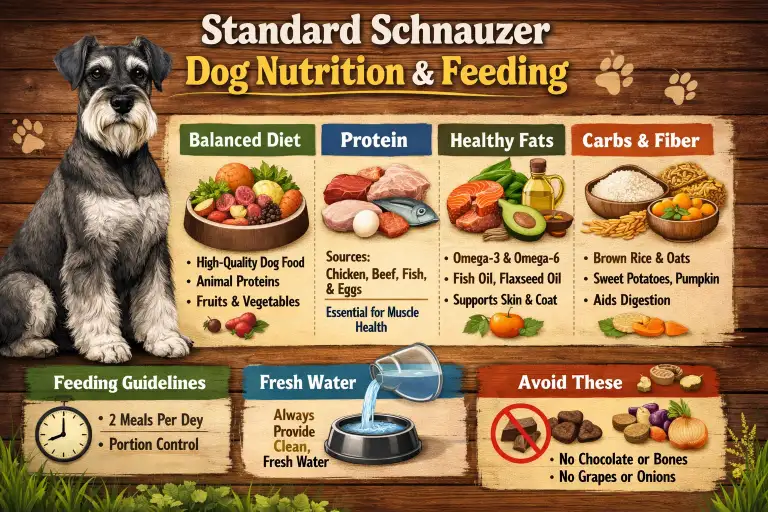
Standard Schnauzers are medium-sized, athletic, and mentally sharp dogs with moderate-to-high daily energy needs. Their nutrition has a direct impact on lean muscle maintenance, digestive stability, skin and coat condition, weight control, and long-term health. This guide is designed to help owners make evidence-based, practical feeding decisions—not follow trends or marketing claims.
Unlike toy breeds with fragile metabolisms or giant breeds with slow growth risks, Standard Schnauzers sit in a metabolic middle ground: they need enough fuel to support activity and muscle tone, but portions must be controlled to avoid gradual weight gain. Many also have sensitive digestion or skin, making ingredient quality and consistency more important than chasing novelty foods.
Veterinary nutrition standards such as AAFCO, FEDIAF, and NRC provide the scientific baseline for balanced canine diets. A properly formulated food that meets these standards—adjusted for your dog’s age, activity, and body condition—covers the vast majority of healthy Standard Schnauzers without the need for routine supplementation.
Core Nutritional Requirements for Standard Schnauzers
| Nutrient | Recommended Range | Why It Matters for Standard Schnauzers |
|---|---|---|
| Protein | ~22–28% (adult) | Supports lean muscle, endurance, and satiety |
| Fat | ~10–16% | Energy source; supports coat and skin health |
| Fiber | ~3–6% | Aids digestion and stool quality |
| Calcium & Phosphorus | Balanced ratio | Bone health, especially in growing puppies |
| Omega-3 & Omega-6 | Diet-dependent | Reduces inflammation; supports skin and coat |
| Vitamins & Trace Minerals | AAFCO/FEDIAF compliant | Metabolism, immunity, and organ function |
Note: Higher protein does not automatically mean “better.” What matters is digestibility, amino acid profile, and balance, not inflated numbers on the label.
How Nutrition Impacts Health in Standard Schnauzers
| Health Area | Role of Proper Nutrition |
|---|---|
| Energy & stamina | Adequate calories and fat prevent fatigue |
| Muscle tone | High-quality protein maintains lean mass |
| Digestive health | Fiber balance reduces gas and loose stool |
| Skin & coat | Essential fatty acids reduce dryness and itching |
| Weight control | Calorie control prevents gradual obesity |
| Long-term health | Balanced micronutrients support organ health |
Breed-Specific Considerations Owners Often Miss
- Weight creep is common: Standard Schnauzers can gain weight slowly without obvious overeating, especially after neutering.
- Food sensitivity shows up early: Recurrent soft stool, itching, or ear issues often point to ingredient intolerance rather than “bad digestion.”
- Consistency beats variety: Frequent food changes increase GI upset more than they improve nutrition.
- Supplements are rarely needed if the base diet is complete and balanced.
Common Nutrition Myths (and Reality)
- Myth: “Grain-free is better for Schnauzers.”
Reality: There’s no breed-specific benefit unless a diagnosed grain sensitivity exists. - Myth: “More protein equals more energy.”
Reality: Calories and fat drive energy; excess protein is simply metabolized or excreted. - Myth: “Home-cooked food is automatically healthier.”
Reality: Homemade diets require professional formulation to avoid deficiencies.
At its core, feeding a Standard Schnauzer well means choosing a complete, balanced diet, controlling portions, and adjusting based on body condition—not the feeding chart alone.
What to Feed a Standard Schnauzer: Best Food Choices
Choosing the right food for a Standard Schnauzer can feel confusing. Pet food labels are full of claims, and online advice often conflicts. The goal is simple: feed a balanced, safe, and easy-to-digest diet that fits your dog’s life and activity level.
A good daily diet should give steady energy, keep stools firm, support skin and coat health, and help your dog stay at a healthy weight. No single food is “perfect” for every Standard Schnauzer, but some choices are clearly better than others.
Common Dog Food Types Compared
| Food Type | Benefits | Drawbacks | Best For |
|---|---|---|---|
| Dry kibble | Easy to store, affordable, complete nutrition | Some brands use low-quality fillers | Most healthy Standard Schnauzers |
| Fresh cooked | High moisture, often very digestible | Expensive, short shelf life | Picky eaters, sensitive stomachs |
| Canned food | Tasty, good hydration | Higher cost, softer stools in some dogs | Dogs needing extra moisture |
| Freeze-dried | Lightweight, nutrient-dense | Costly, must rehydrate | Travel, food rotation |
| Raw diet | High protein, appealing taste | Safety risks, needs balance | Only with expert guidance |
| Homemade | Full ingredient control | High risk of nutrient gaps | Vet-formulated diets only |
Dry kibble that meets AAFCO or FEDIAF standards is the safest and easiest option for most owners. Fresh or canned foods can work well when used carefully and in correct portions.
How to Read a Dog Food Label (Quick Guide)
| Label Part | What to Look For |
|---|---|
| Ingredient list | Named meat first, limited fillers |
| Guaranteed analysis | Protein and fat within healthy ranges |
| Nutrition statement | “Complete and balanced” wording |
| Life stage | Matches puppy, adult, or senior needs |
Ignore phrases like “premium,” “natural,” or “ancestral”. These are marketing terms and do not guarantee quality.
Safe Foods and Toxic Foods for Standard Schnauzers
| Safe Foods (Plain & Cooked) | Foods to Avoid |
|---|---|
| Chicken, turkey, beef | Chocolate |
| Rice, oats | Grapes and raisins |
| Carrots, green beans | Onions and garlic |
| Pumpkin (plain) | Xylitol (sweetener) |
| Eggs | Alcohol, caffeine |
Human foods should only be small extras. They should never replace a balanced dog food.
Treats and Snacks: How Much Is Too Much?
| Treat Type | Feeding Rule |
|---|---|
| Commercial treats | Less than 10% of daily calories |
| Training treats | Small, soft, low-calorie |
| Human food | Occasional only |
| Chews | Supervised and limited time |
Too many treats are one of the top causes of weight gain in Standard Schnauzers.
Grain-Free, Raw, and Homemade Diets: What to Know
Grain-free diets are not healthier by default and may increase heart disease risk when poorly formulated. Raw and homemade diets can work, but only when balanced by a professional. Guessing or copying online recipes often leads to missing nutrients.
For most Standard Schnauzers, a high-quality, balanced commercial diet is the safest and most reliable choice.
How Much to Feed a Standard Schnauzer and How Often
Feeding the right amount is just as important as choosing the right food. Even a healthy food can cause weight gain if portions are too large. Standard Schnauzers are active dogs, but they can still gain weight slowly if meals and treats are not controlled.
There is no single perfect amount for every dog. The correct portion depends on weight, age, activity level, and body shape.
Daily Calorie Needs for Standard Schnauzers
| Dog Weight | Low Activity | Moderate Activity | High Activity |
|---|---|---|---|
| 30 lb (14 kg) | 700–800 kcal | 850–950 kcal | 1,000–1,100 kcal |
| 35 lb (16 kg) | 800–900 kcal | 950–1,050 kcal | 1,100–1,200 kcal |
| 40 lb (18 kg) | 900–1,000 kcal | 1,050–1,150 kcal | 1,200–1,300 kcal |
| 45 lb (20 kg) | 1,000–1,100 kcal | 1,150–1,250 kcal | 1,300–1,400 kcal |
These numbers include all food and treats combined. If treats increase, meals should be reduced.
Feeding Frequency by Life Stage
| Age Group | Meals Per Day | Notes |
|---|---|---|
| Puppy (2–6 months) | 3–4 meals | Supports growth and stable energy |
| Puppy (6–12 months) | 2–3 meals | Reduce slowly as growth slows |
| Adult | 2 meals | Helps prevent hunger and overeating |
| Senior | 2 smaller meals | Easier digestion and weight control |
Skipping meals or feeding once a day often leads to begging, stomach upset, or overeating later.
Portion Size Examples (Real Life)
| Dog Type | Daily Feeding Example |
|---|---|
| Active adult | Full calorie range split into two meals |
| Apartment dog | Lower calorie range, fewer treats |
| Neutered adult | Slightly smaller portions |
| Senior dog | Reduced calories, same protein quality |
Always measure food with a cup or scale. Guessing leads to overfeeding.
Using Body Shape to Adjust Food
| Body Sign | What It Means | Action |
|---|---|---|
| Ribs easy to feel | Healthy weight | Keep feeding same amount |
| No waist visible | Overweight | Reduce food by 10–15% |
| Ribs showing | Underweight | Increase food slowly |
Check your dog’s body shape every month. Small changes early prevent big problems later.
Common Feeding Mistakes
- Feeding by label only without watching body shape
- Giving too many treats during training
- Free-feeding all day
- Not adjusting food after neutering or reduced activity
The best feeding plan is one you adjust over time, not one you set once and forget.
Special Diets, Health Issues, and Real-Life Feeding Situations
Some Standard Schnauzers do great on almost any balanced food. Others need special care with what goes in the bowl. Skin problems, stomach upset, and weight changes are common reasons owners adjust the diet. The key is to change food with a clear reason, not just because a new product looks better.
Diet Changes for Common Health Issues
| Issue | Helpful Diet Focus | What to Avoid |
|---|---|---|
| Food allergies | Limited ingredients, single protein | Frequent food switching |
| Sensitive stomach | Easy-to-digest foods, steady routine | Fatty or rich foods |
| Weight gain | Lower calories, high protein | Free feeding, extra treats |
| Dull coat or itching | Omega-3 rich foods | Low-fat, low-quality diets |
| Loose stool | Added fiber, slow food change | Sudden diet changes |
If problems last more than a few weeks, food may not be the only cause. A vet check is important.
How to Switch Dog Food Safely
| Day | Old Food | New Food |
|---|---|---|
| Days 1–2 | 75% | 25% |
| Days 3–4 | 50% | 50% |
| Days 5–6 | 25% | 75% |
| Day 7+ | 0% | 100% |
If loose stool appears, slow down the switch. Rushing causes problems even with high-quality food.
Feeding a Picky Standard Schnauzer
| Common Behavior | What Usually Helps |
|---|---|
| Skips meals | Set meal times, remove bowl after 20 minutes |
| Waits for treats | Cut treats first, not meals |
| Eats at night only | Keep routine steady for 7–10 days |
| Sniffs and walks away | Avoid adding toppers daily |
Healthy dogs will not starve themselves. Giving in too fast often creates long-term picky eating.
Feeding More Than One Dog
| Challenge | Simple Solution |
|---|---|
| Different food needs | Feed separately |
| One dog eats faster | Use slow-feeder bowls |
| Food guarding | Pick up bowls after meals |
| Weight differences | Measure food for each dog |
Feeding separately avoids stress and helps control portions.
Feeding During Travel or Routine Changes
- Bring your dog’s usual food
- Keep meal times close to normal
- Avoid new treats during travel
- Offer water often
Most stomach problems during travel come from new foods, not stress.
Practical Feeding Tools, FAQs, and When to See a Vet
Sample Daily Feeding Framework
| Life Stage | Meals Per Day | Simple Daily Plan |
|---|---|---|
| Puppy | 3–4 meals | Same food, equal meals, no skipping |
| Adult | 2 meals | Morning + evening, measured portions |
| Senior | 2 smaller meals | Easier digestion, fewer calories |
This is a framework, not a strict rule. Adjust amounts based on body shape and energy level.
Common Feeding Mistakes and Easy Fixes
| Mistake | Why It’s a Problem | Better Choice |
|---|---|---|
| Free-feeding | Causes overeating | Set meal times |
| Too many treats | Hidden calories | Use small training treats |
| Feeding by eye | Leads to weight gain | Measure food |
| Changing food often | Upsets digestion | Stay consistent |
| Ignoring body shape | Misses weight issues | Check monthly |
Small changes made early are much easier than fixing weight problems later.
Common Questions Owners Ask
| Question | Simple Answer |
|---|---|
| My dog acts hungry all the time | Hunger is not always lack of food |
| My dog skips breakfast | Normal for many adults |
| Can I mix foods? | Yes, but keep it consistent |
| Are supplements needed? | Not for balanced diets |
| Can I feed once a day? | Two meals are better |
If your dog is active, happy, and keeping a healthy weight, your feeding plan is likely working.
When to See a Vet or Nutrition Expert
| Warning Sign | Why It Matters |
|---|---|
| Sudden weight loss | May signal illness |
| Weight gain with small meals | Hormonal or metabolic issue |
| Ongoing diarrhea | Not always food-related |
| Constant itching | Could be allergy or skin disease |
| Refusing food for days | Needs medical check |
Food changes do not fix all problems. A vet can rule out health issues before diet changes go too far.
Simple Owner Feeding Checklist
| Weekly Check | Yes / No |
|---|---|
| Meals measured | Yes |
| Treats limited | Yes |
| Waist visible | Yes |
| Stool firm | Yes |
| Energy normal | Yes |
For more guidance on balanced canine nutrition and trusted feeding recommendations, visit the American Kennel Club’s dog nutrition page.

Ata Ur Rehman is the founder of Pet Age in Human Years Calculator, an educational platform that provides age conversion charts and lifespan guides for dogs, cats, birds, and other companion animals. His work focuses on helping pet owners understand how animal ages translate into human years using commonly accepted age conversion formulas and published lifespan averages.
The website compiles breed and species lifespan data from kennel clubs, breed organizations, and general animal lifespan studies to present simple and easy-to-understand guides for pet owners worldwide.
This website was created to centralize animal age conversion charts into one easy reference platform for pet owners.