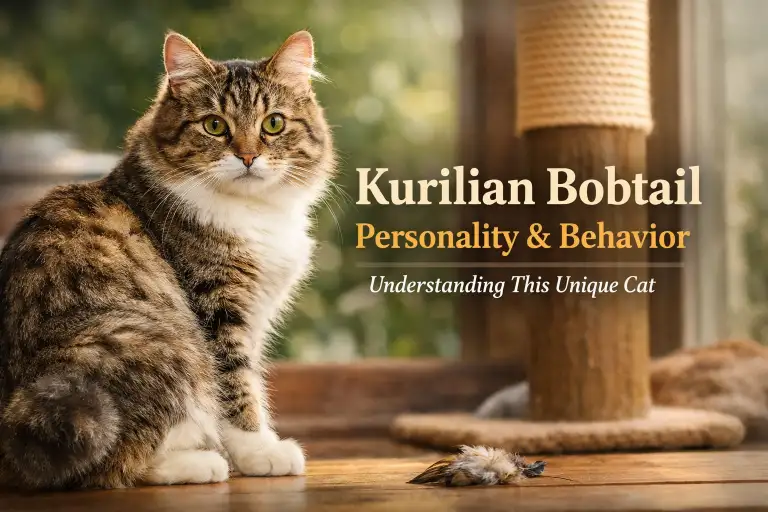
Understanding the Kurilian Bobtail Personality
The Kurilian Bobtail personality is often described with big, catchy labels—intelligent, loyal, dog-like, independent. While none of these are wrong, they’re incomplete. This is a breed whose behavior makes more sense when you stop looking for extremes and start paying attention to how they choose to engage with the world around them.
Kurilian Bobtails tend to be observant cats first and expressive cats second. Many will watch quietly before participating, assess a situation before reacting, and choose when and how to interact rather than responding automatically. This doesn’t mean they’re distant or aloof. It means their social style is deliberate. They notice patterns, routines, and people, and they often form strong opinions about all three.
One of the most important things to understand is that Kurilian Bobtails are not a “one-size-fits-all” personality breed. Two cats can share the same physical traits and still express affection, playfulness, and independence in very different ways. Some lean into close physical contact, while others prefer to stay nearby—on the same couch, in the same room, or just within sight—without demanding touch.
Their confidence is usually quiet rather than showy. Instead of constant attention-seeking, many Kurilian Bobtails show comfort by calmly occupying space, following trusted humans from room to room, or choosing elevated vantage points where they can observe household activity. This balance of independence and connection is a defining feature of the breed.
To ground these traits without falling into stereotypes, it helps to look at how Kurilian Bobtail personality traits commonly appear—and how they’re often misunderstood.
| Personality trait | How it commonly shows up | What owners often misinterpret |
|---|---|---|
| Intelligence | Problem-solving, curiosity, learning routines quickly | “My cat is bored” |
| Confidence | Calm exploration, steady reactions to new situations | “My cat doesn’t need interaction” |
| Independence | Choosing when to engage, self-directed activity | “My cat isn’t affectionate” |
| Loyalty | Following trusted people, preferring familiar humans | “My cat is clingy” |
| Observational nature | Watching quietly before joining in | “My cat is inactive or lazy” |
Understanding the Kurilian Bobtail personality starts with adjusting expectations. These cats often show connection through presence, awareness, and consistency rather than constant physical affection. Once you recognize that, their behavior feels less puzzling and much more intentional—and the bond that develops tends to be calm, steady, and deeply rewarding.
What Shapes Kurilian Bobtail Behavior
Kurilian Bobtail behavior is shaped by a mix of nature and experience. These cats did not come from a carefully designed breeding program. They developed naturally over time, which is why their behavior often feels balanced, steady, and adaptable rather than extreme.
One strong influence is their natural background. Kurilian Bobtails come from island environments where cats needed to be alert, flexible, and good at solving problems. This is why many of them show strong awareness of their surroundings. They notice changes quickly, learn routines fast, and often seem to “think before they act.”
Genetics set the foundation, but daily life shapes how those traits show up. A Kurilian Bobtail raised in a calm home may grow into a relaxed, confident observer. One raised in a busy or unpredictable space may become more cautious or more active. Both are normal. The behavior is not about good or bad personality—it’s about adaptation.
Early experiences matter too. Kittens that are gently exposed to people, sounds, and normal household activity usually grow into adults who handle new situations with more ease. This does not mean a cat with limited early exposure is broken. It simply means they may take more time to feel comfortable and safe.
The home environment continues to shape behavior throughout life. Routine, space, and interaction style all play a role. Kurilian Bobtails often do best when they can choose how to engage. Being able to observe from a high place, explore freely, or rest undisturbed helps them feel secure.
The table below shows common influences on Kurilian Bobtail behavior and how they affect daily actions.
| Influence | How it affects behavior |
|---|---|
| Natural instincts | Strong curiosity, problem-solving, alertness |
| Genetics | Confidence level, activity style, social balance |
| Early experiences | Comfort with people, sounds, and change |
| Home environment | Calmness, play habits, trust |
| Daily routine | Sense of safety and predictability |
Understanding what shapes Kurilian Bobtail behavior helps explain why these cats can act differently in different homes. Their actions are not random. They reflect learning, comfort, and the world they live in.
Social Behavior with Humans and Other Pets
Kurilian Bobtails are social cats, but they often show it in quiet and thoughtful ways. Many people expect affection to look like constant cuddling or sitting on laps. For this breed, affection is often about being nearby, not always being touched.
Some Kurilian Bobtails enjoy lap time, but many prefer to sit close, follow their favorite person from room to room, or rest where they can see what is happening. This is a strong sign of trust. When a Kurilian Bobtail chooses to stay near you, it usually means they feel safe and connected.
They often bond closely with a few people rather than everyone. This does not mean they dislike others. It simply means they are selective. With strangers, they may watch first before deciding to interact. Once they feel comfortable, they often become friendly and curious.
With children, Kurilian Bobtails usually do well when kids are calm and respectful. They tend to walk away instead of reacting when they feel overwhelmed. This makes them a good match for homes that understand cat boundaries.
When it comes to other pets, many Kurilian Bobtails are flexible. They often get along with other cats if introductions are slow and respectful. With dogs, they may show curiosity rather than fear, especially if the dog is calm. Their confidence helps them handle shared spaces without much stress.
Here are some common ways Kurilian Bobtails show affection, even when it’s not obvious.
| Behavior | What it usually means | Why it is often missed |
|---|---|---|
| Sitting nearby | Comfort and trust | “My cat is not cuddly” |
| Following you | Strong bond and interest | “My cat wants food” |
| Slow blinking | Relaxed and friendly feelings | Seen as sleepy behavior |
| Sleeping in the same room | Feeling safe with you | Not noticed as affection |
| Gentle head rubs | Marking you as familiar | Thought to be random |
Understanding these quiet signs helps build a better relationship. Kurilian Bobtails do not always ask for attention, but they often enjoy steady companionship and shared space.
Communication, Play, and Natural Instincts
Kurilian Bobtails communicate in calm and subtle ways. They often use body language more than loud sounds. Watching how they move, sit, and look at you can tell you a lot about how they feel.
Many Kurilian Bobtails are not very noisy cats. Instead of loud meowing, they may use soft chirps, trills, or short sounds to get attention. Some are very quiet and only make sounds when they really want something. Silence usually means they feel safe and relaxed.
Body signals are important. A relaxed body, slow blinking, and a gently moving tail often mean your cat is comfortable. A stiff body, wide eyes, or fast tail movements can mean they are unsure or overstimulated. These small signs are easy to miss, but they help you understand your cat better.
Play is a big part of Kurilian Bobtail behavior. They often enjoy games that let them think and chase. This comes from their natural hunting instincts. Many like toys that move, hide, or change direction. Play is not just for fun—it helps them use energy and stay confident.
Kurilian Bobtails are also known for being curious. They like to explore high places, watch from shelves or windows, and check out new objects. Some even enjoy water, like watching running taps or stepping into shallow water. This curiosity is normal and healthy for the breed.
The table below shows common signals and what they usually mean.
| Signal | What you may see | What it usually means |
|---|---|---|
| Slow blinking | Soft eyes, long blinks | Feeling calm and friendly |
| Chirping or trilling | Short, light sounds | Friendly attention or greeting |
| Tail moving slowly | Gentle side-to-side motion | Relaxed interest |
| Fast tail flicking | Sharp or quick movements | Too much stimulation |
| Focused play stance | Low body, fixed eyes | Hunting or play mode |
Understanding these signals helps you respond in the right way. When you read your cat’s communication correctly, play stays fun and trust stays strong.
Commonly Misunderstood Kurilian Bobtail Behaviors
Kurilian Bobtails often confuse people because their behavior does not match common cat stereotypes. Many of their normal actions are misunderstood, especially by owners who expect constant attention or obvious affection.
One common misunderstanding is independence. When a Kurilian Bobtail spends time alone, it does not mean they are unhappy or distant. Many simply enjoy choosing when to rest, watch, or interact. This choice is part of their confident nature.
Quiet behavior is another area of confusion. A Kurilian Bobtail may sit and watch for long periods without moving much. This is not boredom. It is focus. These cats like to observe their space and feel comfortable knowing what is happening around them.
Play can also be misunderstood. Kurilian Bobtails may play with strong focus and quick movements. To some people, this looks aggressive. In most cases, it is healthy hunting-style play. As long as the body stays loose and the cat can stop easily, this play is normal.
Changes in behavior over time can worry owners too. As Kurilian Bobtails grow older, they may play less, sleep more, or prefer quieter spaces. These changes often come with age and do not always mean something is wrong.
The table below shows normal behaviors and how they are often mistaken for problems.
| Behavior | Common worry | What it usually means |
|---|---|---|
| Spending time alone | “My cat is lonely” | Comfortable and confident |
| Watching quietly | “My cat is bored” | Alert and relaxed |
| Strong play focus | “My cat is aggressive” | Natural hunting play |
| Following routines | “My cat is picky” | Feels safe with structure |
| Less activity with age | “My cat is unhappy” | Normal life stage change |
Understanding these behaviors helps reduce worry and builds trust. Kurilian Bobtails are steady, thoughtful cats. When you learn to read their actions with patience, their behavior feels clear and predictable.
For readers who want to explore more about cat behavior and communication in general, the Cornell Feline Health Center offers clear, science-based information that helps explain why cats act the way they do:
https://www.vet.cornell.edu/departments-centers-and-institutes/cornell-feline-health-center/health-information/cat-behavior

Ata Ur Rehman is the founder of Pet Age in Human Years Calculator, an educational platform that provides age conversion charts and lifespan guides for dogs, cats, birds, and other companion animals. His work focuses on helping pet owners understand how animal ages translate into human years using commonly accepted age conversion formulas and published lifespan averages.
The website compiles breed and species lifespan data from kennel clubs, breed organizations, and general animal lifespan studies to present simple and easy-to-understand guides for pet owners worldwide.
This website was created to centralize animal age conversion charts into one easy reference platform for pet owners.