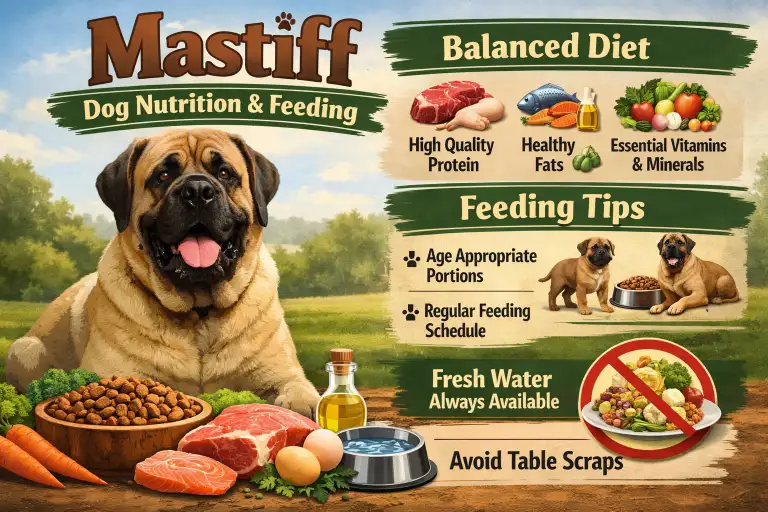
Mastiffs are not just “big dogs.” They are giant-breed dogs with unique nutritional risks and needs, and feeding them like a regular large dog can quietly cause long-term problems. This guide starts with that reality, because getting nutrition right for a Mastiff is less about feeding more food and more about feeding correctly.
Mastiffs grow fast, carry enormous body weight, and place heavy mechanical stress on their bones, joints, heart, and digestive system. Nutrition directly affects how safely they grow, how well they move as adults, and how long they stay comfortable in their senior years. Mistakes made early—especially during puppyhood—often don’t show up immediately, but they can lead to joint disease, obesity, chronic pain, or reduced lifespan later on.
Unlike smaller breeds, Mastiffs:
- Have slower skeletal maturation, meaning rapid weight gain can damage developing joints
- Are at higher risk of orthopedic issues such as hip and elbow dysplasia
- Are prone to obesity, even when owners feel they’re feeding “normal” amounts
- Have an increased risk of bloat (GDV), which makes feeding style and meal timing critical
Another common misconception is that a Mastiff needs extremely high protein or calorie-dense food simply because of their size. In reality, overfeeding calories and minerals is far more dangerous than slightly underfeeding in this breed. Excess energy, calcium, or phosphorus—especially in puppies—can push growth too fast and overwhelm the skeleton before it’s ready to support adult weight.
Proper Mastiff nutrition focuses on:
- Controlled growth, not maximum growth
- Balanced nutrients, not exaggerated protein or supplements
- Portion accuracy, not guesswork or free-feeding
- Long-term joint and metabolic health, not short-term size or bulk
Owners often don’t realize that many feeding problems seen in adult Mastiffs—difficulty standing up, stiffness, early arthritis, constant hunger, or weight gain despite “reasonable” portions—are linked to feeding decisions made months or even years earlier.
That’s why this guide is built to help you understand why Mastiff nutrition is different before telling you what to feed and how much. When you understand the reasoning behind Mastiff-specific feeding, the practical decisions become far clearer—and far safer for your dog.
What to Feed a Mastiff: Nutritional Requirements Explained Simply
Feeding a Mastiff is not about giving the biggest bowl or the richest food. It is about balance, control, and safety. Mastiffs need the right nutrients in the right amounts to support their size without damaging their joints, digestion, or long-term health.
Many feeding problems in Mastiffs come from food that is:
- Too high in calories
- Too high in calcium for puppies
- Chosen based on marketing, not nutrition
Core Nutrients Mastiffs Need
Mastiffs need the same basic nutrients as all dogs, but the levels and balance matter more because of their giant size.
- Protein helps build muscle and maintain strength
- Fat provides energy and supports skin and coat
- Carbohydrates and fiber support digestion and gut health
- Calcium and phosphorus build bones, but too much is dangerous
- Vitamins and minerals support immunity, metabolism, and joints
The goal is steady growth and healthy weight, not fast size gain.
Ideal Nutrient Ranges for Mastiff Dogs
| Nutrient | Mastiff Puppy | Adult Mastiff | Senior Mastiff |
|---|---|---|---|
| Protein | 22–26% | 20–24% | 18–22% |
| Fat | 12–15% | 10–14% | 8–12% |
| Calcium | 1.0–1.3% | 0.8–1.2% | 0.6–1.0% |
| Phosphorus | 0.8–1.1% | 0.6–1.0% | 0.5–0.8% |
These ranges support muscle while protecting bones and joints. More is not better for Mastiffs, especially puppies.
Why Calcium Control Is Critical for Mastiff Puppies
One of the biggest feeding mistakes is giving Mastiff puppies food or supplements with too much calcium.
Too much calcium can:
- Cause abnormal bone growth
- Increase the risk of hip and elbow problems
- Lead to joint pain later in life
Healthy Mastiff puppies do not need calcium supplements if they are eating a properly formulated large- or giant-breed puppy food.
How to Read a Dog Food Label for Mastiffs
Dog food bags can be confusing. Focus on facts, not fancy words.
| Label Item | What It Really Means | What to Do |
|---|---|---|
| “Complete & Balanced” | Meets basic nutrition standards | Required for daily feeding |
| “Large/Giant Breed” | Mineral levels are controlled | Strongly recommended |
| First ingredient meat | Shows protein source | Good, but not the only factor |
| Grain-free | No grains included | Not required for Mastiffs |
| Added supplements | Extra vitamins or minerals | Avoid excess in puppies |
Avoid foods that promise:
- “Maximum growth”
- “Extra calcium for big dogs”
- “High energy for rapid muscle gain”
These claims often cause more harm than good in Mastiffs.
Grain-Free Diets and Mastiffs
Grain-free food is not automatically better for Mastiffs.
Unless your Mastiff has a proven grain allergy, grain-free diets:
- Do not improve joints
- Do not prevent bloating
- Do not increase lifespan
Some grain-free diets have been linked to heart problems when poorly formulated. For most Mastiffs, a well-made food with grains is safe and healthy.
Simple Takeaway for Owners
A good Mastiff diet should:
- Be made for large or giant breeds
- Have controlled calories and minerals
- Match your dog’s age and activity level
- Avoid unnecessary supplements
If a food looks extreme or promises fast results, it is usually the wrong choice for a Mastiff.
How Much Should a Mastiff Eat? Feeding Amounts, Calories, and Schedules
One of the most common questions Mastiff owners ask is “Am I feeding too much or too little?”
Because Mastiffs are very large dogs, even small feeding mistakes can lead to fast weight gain, joint stress, or slow growth problems.
The key is portion control, steady growth, and regular adjustment as your Mastiff ages.
Mastiff Feeding Chart by Weight and Life Stage
This table gives general daily feeding amounts for healthy Mastiffs eating dry food. Exact needs can vary by food brand and activity level.
| Mastiff Weight | Puppy (cups/day) | Adult (cups/day) | Senior (cups/day) |
|---|---|---|---|
| 80–100 lbs | 4–6 | 4–5 | 3–4 |
| 100–130 lbs | 5–7 | 5–6 | 4–5 |
| 130–160 lbs | 6–8 | 6–7 | 5–6 |
| 160–200 lbs | 7–9 | 7–8 | 6–7 |
These amounts should be split into meals, not fed all at once.
Estimated Daily Calorie Needs for Mastiffs
| Activity Level | Calories per Day (Adult Mastiff) |
|---|---|
| Low activity (couch dog) | 2,000–2,400 |
| Moderate activity | 2,400–3,000 |
| High activity / working | 3,000–3,600 |
Puppies and growing Mastiffs need carefully controlled calories, not unlimited food.
How Often Should You Feed a Mastiff?
| Age | Meals per Day | Why It Matters |
|---|---|---|
| Puppy (under 6 months) | 3 meals | Supports safe growth |
| Puppy (6–18 months) | 2–3 meals | Prevents rapid weight gain |
| Adult | 2 meals | Reduces bloat risk |
| Senior | 2 smaller meals | Easier digestion |
Avoid feeding one large meal per day.
Why Free-Feeding Is a Bad Idea for Mastiffs
Leaving food out all day often causes:
- Overeating
- Fast weight gain
- Poor appetite control
- Higher bloat risk
Mastiffs do best with measured meals at set times.
Using Body Condition Instead of Guessing
Instead of guessing by the bowl, watch your dog’s body.
Your Mastiff should:
- Have a waist when viewed from above
- Not have ribs sticking out
- Not feel thick layers of fat over the ribs
If your Mastiff is gaining weight:
- Reduce food slightly
- Cut back on treats
- Increase gentle activity
If your Mastiff looks thin or low energy:
- Increase portions slowly
- Check food quality
- Speak to your vet
Simple Takeaway for Owners
Healthy Mastiff feeding means:
- Measured portions
- Two meals per day
- Calories matched to activity
- Regular weight checks
Big dogs do not need big mistakes.
Best Diet Types for Mastiffs (Kibble, Raw, Fresh, Homemade)
There is no single “perfect” diet for every Mastiff. The best food is one that keeps your dog lean, active, and comfortable, while also being safe and easy for you to manage.
What matters most is balance, portion control, and quality, not trends or expensive labels.
Common Diet Types for Mastiffs Compared
| Food Type | Pros | Cons | Best For |
|---|---|---|---|
| Dry kibble | Easy to store, affordable, balanced | Can be high in calories | Most Mastiff owners |
| Canned food | Tasty, high moisture | Expensive, easy to overfeed | Picky eaters, seniors |
| Fresh cooked food | Highly digestible, appealing | Costly, needs planning | Sensitive stomachs |
| Raw diet | High protein, less processing | Risk of bacteria, imbalance | Experienced owners only |
| Homemade meals | Full control of ingredients | Easy to unbalance nutrients | Only with vet guidance |
Most Mastiffs do very well on a high-quality large or giant breed kibble, sometimes mixed with small amounts of fresh food.
Grain-Free, Raw, and Trendy Diets: What Owners Should Know
Grain-free diets are not required for Mastiffs unless your dog has a confirmed allergy.
Raw and homemade diets can work, but:
- They must be properly balanced
- Mistakes can cause bone and joint problems
- Puppies are at higher risk if diets are poorly made
For many owners, the safest choice is a commercial food made for large or giant breeds.
Safe vs Unsafe Human Foods for Mastiffs
| Safe Foods (Small Amounts) | Unsafe or Toxic Foods |
|---|---|
| Cooked chicken or turkey | Chocolate |
| Plain rice or oatmeal | Grapes and raisins |
| Carrots, green beans | Onions and garlic |
| Pumpkin (plain) | Xylitol (sweetener) |
| Eggs (cooked) | Alcohol |
Human food should never replace a balanced dog diet.
Treat Guidelines for Mastiffs
| Treat Type | How Often | Portion Tip |
|---|---|---|
| Training treats | Daily | Use pea-sized pieces |
| Chews | Few times per week | Supervise always |
| Human food treats | Rare | Count as part of meals |
Treats should make up less than 10% of daily calories.
Simple Takeaway for Owners
The best Mastiff diet is:
- Balanced, not extreme
- Easy to measure
- Safe for joints and digestion
- Matched to your dog’s age and activity
If a diet feels complicated or risky, it usually is.
Common Mastiff Feeding Problems, Special Diets, and Practical Tips
Even when owners try their best, feeding problems are very common in Mastiffs. Their large size, slow movement, and sensitive digestion mean small mistakes can turn into big issues over time.
The good news is that most feeding problems can be fixed with simple changes.
Common Mastiff Feeding Problems and Simple Fixes
| Problem | Common Cause | What Usually Helps |
|---|---|---|
| Weight gain | Too many calories or treats | Reduce portions, cut treats |
| Always hungry | Food too low in fiber | Switch to higher-fiber food |
| Loose stool | Food change too fast | Slow transition over 7–10 days |
| Not eating meals | Too many snacks | Remove treats, set meal times |
| Fast eating | Competition or habit | Use slow feeder bowl |
Most Mastiffs do not need more food. They need better portion control.
Special Diet Needs in Mastiffs
| Situation | Diet Focus | What to Avoid |
|---|---|---|
| Joint problems | Controlled calories, omega-3 fats | High-calorie foods |
| Sensitive stomach | Simple ingredients, easy digestion | Sudden food changes |
| Overweight | Lower calories, more fiber | Free-feeding |
| Low activity | Reduced portions | High-fat foods |
| Food allergies | Limited ingredients | Common trigger proteins |
Never change food suddenly, especially for sensitive Mastiffs.
Mastiffs are at higher risk for bloat, a serious stomach condition.
| Topic | Guidelines / Tips |
|---|---|
| Fast Eating and Bloat Risk | – Feed two meals per day, not one – Use slow feeder bowls – Avoid exercise right before or after meals – Keep feeding times calm (These steps lower risk but do not guarantee prevention) |
| Switching Foods Safely | – Mix new food slowly over 7–10 days – Watch stool, appetite, and energy – Slow down if diarrhea appears (Rushing food changes is a common mistake) |
| When to See a Vet or Nutrition Expert | – Loses or gains weight without reason – Has long-term diarrhea or vomiting – Refuses food for more than 24–48 hours – Has joint pain or trouble standing (Large dogs hide problems; early help matters) |
| Simple Takeaway for Owners | – Measure food – Watch body shape – Limit treats – Adjust as your dog ages (Small changes done early protect your Mastiff for life) |
This table is skimmable, easy for a 7th-grade reader, and highlights the most important actions and warnings clearly.
For more expert guidance on large-breed dog nutrition, you can visit the American Kennel Club’s Mastiff Care Guide.

Ata Ur Rehman is the founder of Pet Age in Human Years Calculator, an educational platform that provides age conversion charts and lifespan guides for dogs, cats, birds, and other companion animals. His work focuses on helping pet owners understand how animal ages translate into human years using commonly accepted age conversion formulas and published lifespan averages.
The website compiles breed and species lifespan data from kennel clubs, breed organizations, and general animal lifespan studies to present simple and easy-to-understand guides for pet owners worldwide.
This website was created to centralize animal age conversion charts into one easy reference platform for pet owners.