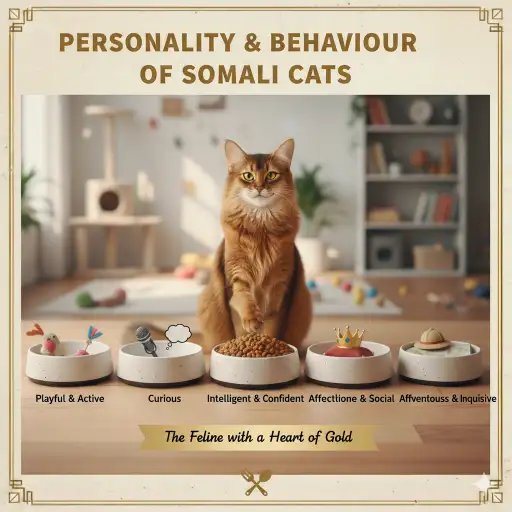
Somali cats are often described as lively, curious, and full of energy. They are sometimes called the “fox cats” because of their bushy tails and bright, alert expressions. But their personality is even more noticeable than their looks. Living with a Somali cat usually means living with a cat that wants to be involved in everything happening around the home.
One of the most striking traits of the Somali cat is their playful nature. Many owners notice that Somalis keep a kitten-like spirit well into adulthood. They often enjoy chasing toys, exploring new spaces, and turning everyday objects into entertainment. A Somali may treat a paper bag, a moving curtain, or even a shoelace like an exciting discovery.
Somali cats are also known for their intelligence. They quickly learn routines, recognize patterns, and often find creative ways to get what they want. This does not mean they are “naughty.” Instead, it reflects a curious mind that enjoys problem-solving and interaction. A Somali may figure out how to open cabinets, reach high shelves, or signal when they want attention.
Emotionally, many Somalis are deeply connected to their humans. While every cat is different, this breed often forms strong bonds with household members. Some Somalis love sitting on laps, while others prefer staying close by rather than directly on you. This variation is normal and reflects individual personality rather than breed rules.
Here is a quick overview of common Somali personality tendencies:
| Personality Trait | Typical Somali Tendency |
|---|---|
| Energy Level | High, very active |
| Playfulness | Very playful, enjoys games |
| Intelligence | Highly curious and observant |
| Affection Style | Social, often people-oriented |
| Independence | Balanced, enjoys company but not clingy |
| Vocalization | Moderately talkative, soft sounds |
It is important to remember that these are tendencies, not guarantees. Some Somalis are calmer, some are more vocal, and some are extra affectionate. Personality always includes both breed influence and individual variation.
How Somali Cats Communicate
Somali cats communicate constantly, even when they are silent. Much of their communication happens through body language. Understanding these signals helps owners better interpret what their cat is feeling or wanting at any moment.
The tail is one of the clearest indicators. A relaxed Somali often holds their tail upright with a gentle curve at the tip. This usually signals comfort and confidence. A fast-moving tail, especially when flicking sharply, can indicate excitement or mild irritation. Context matters — during play, tail flicking may simply show high energy rather than annoyance.
Ears and eyes also provide useful clues. Forward-facing ears often signal curiosity or interest. Ears turned sideways or slightly back may suggest uncertainty or overstimulation. A Somali with soft, half-closed eyes is typically relaxed, while wide eyes often reflect alertness or excitement.
Somali cats are also known for their soft vocalizations. Instead of loud, demanding meows, many Somalis use chirps, trills, and gentle sounds. These noises often accompany interaction, such as greeting you, requesting play, or responding to movement.
Here is a simple guide to common Somali communication signals:
| Signal | Possible Meaning |
|---|---|
| Tail upright | Friendly, confident, comfortable |
| Tail flicking during play | Excited, focused, stimulated |
| Slow blinking | Relaxed, trusting |
| Soft chirping | Greeting, curiosity, engagement |
| Trilling sound | Friendly interaction, mild request |
| Sudden silence and stillness | Deep focus or alertness |
Many Somali owners notice that these cats are very expressive. They often “talk” through movement, posture, and subtle sounds rather than dramatic vocal displays. This can make them feel highly interactive and socially responsive.
Learning your Somali’s personal communication style is key. Over time, owners begin to recognize small differences: a specific chirp for food, a different sound for play, or a unique posture for relaxation.
Social Behavior with Humans & Other Pets
Somali cats are widely recognized for their social nature. Many enjoy being near people and actively participating in household life. This does not always mean constant cuddling. Instead, Somalis often show social connection through proximity and involvement.
Some Somalis are classic lap cats, happily settling onto their owner’s legs. Others prefer sitting beside you, following you from room to room, or supervising activities from nearby furniture. Both patterns are normal expressions of affection.
Somalis frequently display what owners describe as “shadowing” behavior. A Somali may trail behind you, observe your actions, or sit close during daily routines. This behavior is typically driven by curiosity and social interest rather than dependency.
With other cats, Somalis often show playful and interactive tendencies. They usually enjoy companionship, especially if introduced carefully. Their high energy often leads to active play sessions with feline housemates.
Interactions with dogs can also be positive. Somalis tend to be confident and curious, traits that can support peaceful cohabitation. Proper introductions and respect for boundaries remain important.
Here is a simplified comparison of Somali social tendencies:
| Interaction Type | Typical Somali Response |
|---|---|
| With primary owner | Strong bond, seeks engagement |
| With family members | Generally friendly, curious |
| With unfamiliar humans | Alert but often curious |
| With other cats | Playful, interactive |
| With dogs | Often adaptable if socialized |
Somali cats often enjoy interactive attention. They may initiate games, bring toys, or create playful scenarios. Their social style is active rather than passive.
It is also common for Somalis to balance independence with connection. They may seek play and interaction but also value personal exploration and rest. This flexibility is part of their charm.
Understanding your Somali’s individual social preferences helps create a comfortable environment. Some may crave frequent interaction, while others prefer shorter but intense bursts of activity.
Natural Instincts: Play, Exploration & Energy
Somali cats are known for their high energy and curiosity. These traits are closely tied to natural feline instincts. Many behaviors that owners observe are simply expressions of hunting, exploring, and problem-solving drives.
Play behavior in Somalis often mimics hunting. Chasing, stalking, pouncing, and batting are all instinct-driven actions. A Somali may treat toys like prey, focusing intensely before launching into quick, athletic movements.
Exploration is another defining feature. Somalis often investigate new objects, climb elevated surfaces, and monitor changes in their environment. Their curiosity frequently leads them to high perches, shelves, or unexpected hiding spots.
Climbing and jumping are common. These behaviors reflect both physical agility and a desire for vantage points. Elevated spaces offer safety, stimulation, and observational opportunities.
Providing enrichment helps satisfy these instincts. This does not mean expensive equipment is required. Many Somalis enjoy simple, engaging activities:
| Enrichment Idea | Why It Works |
|---|---|
| Interactive wand toys | Triggers chase and pounce instincts |
| Puzzle feeders | Engages intelligence and curiosity |
| Cat trees and shelves | Supports climbing and observation |
| Rotating toys | Prevents boredom through novelty |
| Window perches | Provides visual stimulation |
Somalis often thrive in environments that offer mental and physical engagement. Without stimulation, their curiosity may shift toward household items, not out of misbehavior but from natural drive.
Nighttime activity is also common. Like many cats, Somalis are often more active at dawn and dusk. This reflects natural crepuscular rhythms rather than problematic behavior.
Understanding the link between instinct and behavior helps owners interpret actions more accurately. A Somali climbing curtains or exploring cabinets is usually expressing curiosity and energy, not defiance.
Common Behavior Patterns & What They Mean
Many Somali behaviors can surprise new owners. Their intelligence, energy, and curiosity sometimes lead to actions that appear unusual or confusing. In most cases, these behaviors are normal expressions of personality.
For example, Somali cats often display intense curiosity. They may inspect bags, boxes, visitors, or any environmental change. This investigative behavior reflects a highly engaged mind.
Some Somalis are moderately vocal. Their sounds are often soft, varied, and conversational. Owners sometimes misinterpret vocalization as dissatisfaction, when it often signals communication or engagement.
Play intensity can also be misunderstood. Somali play may involve fast movements, mock stalking, and energetic pouncing. This usually reflects excitement rather than aggression.
Here are common Somali behaviors with possible interpretations:
| Behavior | Typical Meaning |
|---|---|
| Following owners | Social interest, curiosity |
| Sudden bursts of running | Energy release, play drive |
| Climbing high spaces | Seeking vantage points |
| Gentle vocal sounds | Communication, interaction |
| Toy “obsession” | Strong hunting instincts |
Somali cats may also show strong interest in routines. They often recognize feeding times, play schedules, and daily patterns. This predictability provides comfort and structure.
Changes in behavior often reflect environmental shifts. New furniture, visitors, schedule changes, or altered household dynamics can influence activity patterns.
It is helpful to observe trends rather than isolated moments. A Somali having a highly energetic day is normal. A Somali occasionally hiding is also normal. Context always matters.
Celebrating a Somali’s personality means appreciating their curiosity, playfulness, and expressiveness. These traits are central to the breed’s appeal.
Living with a Somali cat often feels like living with an intelligent, playful companion who actively participates in home life. Their behaviors are best understood through observation, patience, and connection.
For more general breed information, you can explore resources like the International Cat Care breed library:
https://icatcare.org/advice/somali-cat/

Ata Ur Rehman is the founder of Pet Age in Human Years Calculator, an educational platform that provides age conversion charts and lifespan guides for dogs, cats, birds, and other companion animals. His work focuses on helping pet owners understand how animal ages translate into human years using commonly accepted age conversion formulas and published lifespan averages.
The website compiles breed and species lifespan data from kennel clubs, breed organizations, and general animal lifespan studies to present simple and easy-to-understand guides for pet owners worldwide.
This website was created to centralize animal age conversion charts into one easy reference platform for pet owners.