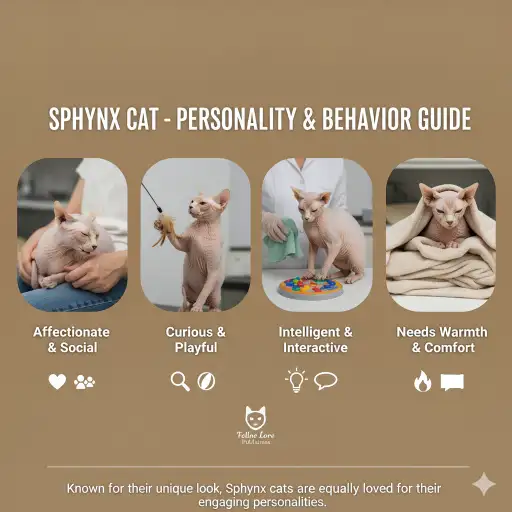
The Sphynx cat is often described as one of the most people-oriented cat breeds in the world. While many cats enjoy affection on their own terms, the Sphynx is widely known for actively seeking human contact. Owners frequently notice their Sphynx following them from room to room, climbing onto laps, or curling up against shoulders. This behavior is not random or needy in a negative sense. It reflects a strong social nature combined with curiosity and a desire for warmth and interaction.
One of the most striking personality traits of the Sphynx is its high level of social engagement. These cats tend to enjoy being part of daily activities rather than observing from a distance. A Sphynx may sit beside you while you work, inspect whatever you are holding, or insert itself into household routines. Many owners describe them as “dog-like,” not because they behave exactly like dogs, but because they often show a strong interest in companionship and shared attention.
Affection in Sphynx cats can appear very direct. While some cats show love quietly, the Sphynx often expresses attachment through physical closeness. They may press their body against their owner, sleep under blankets, or rest in warm spots near people. This tendency is influenced partly by their lack of fur, which makes warmth especially comforting. However, warmth seeking is only part of the story. The breed also has a well-recognized tendency toward strong bonding behavior.
Despite common stereotypes, Sphynx cats are not identical in personality. Some are extremely outgoing and playful, while others are calmer and more observant. Individual differences are shaped by genetics, early experiences, environment, and social exposure. Even within the same household, two Sphynx cats may show different affection styles. One may be a constant lap companion, while another prefers to stay nearby without being held.
How Sphynx Communicate and Express Emotion
Sphynx cats are highly expressive animals, both in body language and vocal behavior. Their lack of fur often makes their movements and posture easier to read. Small changes in ear position, tail movement, or body tension can communicate comfort, curiosity, excitement, or caution. Because their skin is fully visible, even subtle shifts in posture tend to stand out more clearly compared to long-haired breeds.
Like all cats, Sphynx use their ears as important communication tools. Forward-facing ears often signal interest or engagement, while flattened ears may indicate discomfort or irritation. A gently moving tail may show curiosity or mild excitement, whereas rapid tail flicking often suggests overstimulation. These signals are normal parts of feline communication and should be interpreted within the context of the cat’s environment and situation.
Vocalization is another notable characteristic. Many Sphynx cats are described as talkative. They may chirp, trill, or produce soft meows during interaction with humans. These sounds are not simply noise. They often accompany social behavior, attention seeking, or response to stimuli. Some Sphynx develop unique “conversation” patterns with their owners, producing sounds when greeted, touched, or spoken to.
Facial expressions also play a role. Without fur to soften visual cues, changes around the eyes and mouth may be more noticeable. A relaxed Sphynx often shows soft eyes and a loose posture, while stress may be reflected through widened eyes or body stiffness. Recognizing these cues helps owners better understand what their cat is feeling rather than relying on assumptions.
Common Communication Signals in Sphynx Cats
| Signal | Typical Meaning | Owner Observation Tip |
|---|---|---|
| Forward ears | Interest / curiosity | Seen during play or exploration |
| Slow blinking | Relaxation / trust | Often occurs during calm interaction |
| Gentle tail movement | Mild engagement | Normal during social moments |
| Rapid tail flicking | Overstimulation | May indicate need for space |
| Soft vocal sounds | Social interaction | Common during attention seeking |
Social Behavior with People, Other Cats & Pets
Sphynx cats are widely recognized for their strong attachment to humans. Many individuals prefer staying close to their owners and actively participating in household life. This does not mean they cannot be independent, but they often display a clear interest in companionship. A Sphynx may seek out physical contact, choose to sit near people, or follow familiar individuals around the home.
This breed often forms deep bonds with specific household members. Some cats show preference for one person, while others distribute their affection more evenly. These patterns are influenced by early social experiences, daily routines, and individual temperament. Strong bonding is normal feline behavior, particularly in socially inclined breeds.
Interactions with other cats are typically positive when introductions are handled gradually. Sphynx cats often display curiosity and sociability toward feline companions. They may engage in shared sleeping, grooming, or play. However, personality differences still matter. Some individuals are more assertive, while others are cautious or selective in their social engagement.
Behavior with dogs and other pets varies but is often adaptable. Many Sphynx cats tolerate or even enjoy multi-pet households, especially when exposed to other animals early in life. Their confident and curious nature can support smoother adjustment. As with all cats, successful social relationships depend on environment, personality compatibility, and respectful boundaries.
Typical Social Tendencies
| Behavior Pattern | Common Expression |
|---|---|
| Human attachment | Frequently seeks proximity |
| Response to visitors | Often curious rather than fearful |
| Multi-cat interaction | Usually social if well introduced |
| Dog interaction | Often adaptable with calm dogs |
Play, Energy, Curiosity & Instincts
Sphynx cats are often described as energetic, curious, and mentally engaged animals. Many individuals enjoy interactive play, exploring new objects, and investigating changes in their environment. Their behavior reflects natural feline instincts combined with breed-specific tendencies toward social interaction and stimulation.
Play serves multiple roles. It supports physical activity, mental engagement, and social bonding. A Sphynx may show strong interest in toys that involve movement, chasing, or problem solving. Puzzle feeders, interactive wands, and climbing structures often attract attention. These preferences align with the cat’s natural predatory instincts rather than breed-specific training.
Curiosity is another defining characteristic. Sphynx cats frequently investigate new sounds, smells, and objects. They may climb, perch, or explore elevated spaces. Scratching and climbing behaviors are normal feline activities linked to territory marking, muscle stretching, and environmental exploration.
Energy levels vary by individual and life stage. Kittens and young adults typically display higher activity levels, while older cats may show calmer patterns. Rest remains equally important. Even highly playful Sphynx cats spend significant time sleeping, often seeking warm and comfortable resting areas.
Common Questions Owners Ask About Sphynx Behavior
| Question | Insight |
|---|---|
| Why does my Sphynx follow me everywhere? | Many Sphynx display strong social bonding and curiosity |
| Are Sphynx cats clingy? | They are often affectionate, but personality varies |
| Why do they love blankets? | Warmth and comfort are highly appealing |
| Are Sphynx cats very vocal? | Many communicate frequently through soft sounds |
| Do Sphynx get along with other pets? | Often yes, especially with gradual introductions |
| Are they playful at all ages? | Playfulness may change but often remains present |
Sphynx cats are complex, expressive, and highly individual animals. Their personalities combine affection, curiosity, intelligence, and social engagement. Understanding these patterns helps owners interpret behavior more accurately and respond with empathy rather than assumptions.For readers interested in broader feline behavior science, you may explore resources from the International Cat Care organization:
https://icatcare.org

Ata Ur Rehman is the founder of Pet Age in Human Years Calculator, an educational platform that provides age conversion charts and lifespan guides for dogs, cats, birds, and other companion animals. His work focuses on helping pet owners understand how animal ages translate into human years using commonly accepted age conversion formulas and published lifespan averages.
The website compiles breed and species lifespan data from kennel clubs, breed organizations, and general animal lifespan studies to present simple and easy-to-understand guides for pet owners worldwide.
This website was created to centralize animal age conversion charts into one easy reference platform for pet owners.