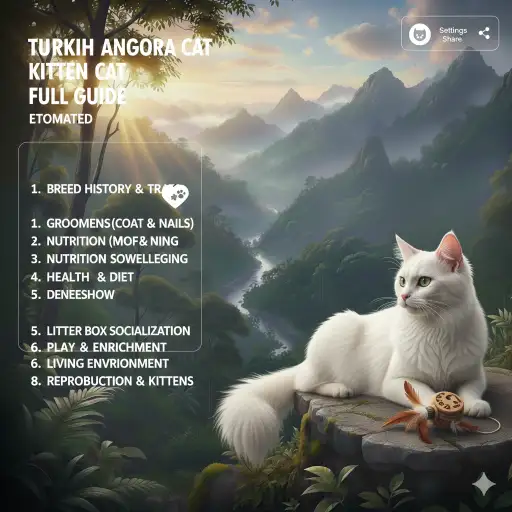
The Turkish Angora is one of the oldest natural cat breeds in the world. It comes from Turkey, especially from the Ankara region, which was once called Angora. For many centuries, these elegant cats lived in homes and royal courts. They were admired for their silky white coats and striking eyes. Today, the Turkish Angora is still known for beauty, grace, and sharp intelligence.
Major cat organizations like the Cat Fanciers’ Association and The International Cat Association officially recognize the breed. While many people think all Turkish Angoras are white, they actually come in many colors and patterns. White cats are the most famous, especially those with odd-colored eyes, but black, blue, cream, red, and tabby Turkish Angoras also exist.
In size, the Turkish Angora is a medium cat. Most females weigh between 5 to 9 pounds (2.5–4 kg). Males are slightly larger, usually 8 to 12 pounds (3.5–5.5 kg). They look slim and fine-boned, but do not be fooled. Under that silky coat is a strong and athletic body. They move like dancers — light, smooth, and very balanced. Their long legs and long plumed tail give them a royal look.
Their coat is different from many other longhaired cats. The Turkish Angora has a single-layer coat. This means they do not have a thick undercoat like a Persian or Norwegian Forest Cat. Because of this, their fur feels soft and silky, and it rarely mats. The coat is shorter in summer and fuller in winter. Many owners are surprised that this longhaired cat does not require heavy grooming.
Their eyes are almond-shaped and slightly slanted. Eye colors include blue, green, gold, amber, or odd-eyed (one blue and one gold or green). White Turkish Angoras with blue eyes have a higher risk of deafness, especially if both eyes are blue. We will explain more about this later.
Here is a quick snapshot of the breed:
| Trait | Turkish Angora |
|---|---|
| Size | Medium |
| Weight | 5–12 lbs |
| Lifespan | 12–18 years |
| Energy Level | High |
| Grooming Needs | Moderate |
| Affection Level | High (selective) |
| Shedding | Moderate |
| Vocalization | Soft but expressive |
The Turkish Angora is not a heavy, round cat. Compared to the flat-faced Persian, it has a wedge-shaped head and normal nose. Compared to the large Maine Coon, it is much lighter and more delicate in build. If you want a cat that looks elegant and athletic instead of fluffy and bulky, this breed stands out.
Turkish Angora Personality and Temperament: What Living With One Is Really Like
Living with a Turkish Angora is exciting. These cats are very smart. They learn fast, observe everything, and like to be involved in your daily life. Many owners say their Turkish Angora follows them from room to room like a shadow. They often choose one favorite person in the home and bond deeply with them.
They are affectionate, but not always in a quiet way. Instead of sitting still for hours, they prefer active closeness. They may sit beside you, climb onto your shoulders, or sleep near your pillow at night. Some are lap cats, but many prefer being close rather than fully held.
Energy level is high. These cats love to climb. If you do not provide a tall cat tree, they may use your shelves or curtains. They enjoy jumping to high places and watching the room from above. Fetch is a common game for this breed. Many Turkish Angoras will bring back small toys again and again.
They are usually friendly with children if the child is gentle. Rough handling will not be tolerated. With other cats, they can be confident or even dominant. In multi-cat homes, they may try to become the leader. They often do well with calm dogs if introduced slowly.
They are not very loud, but they will talk to you. Their voice is soft and sweet. They use it to ask for attention or express feelings. They are not as talkative as a Siamese, but they are more vocal than a Persian.
Here is how they fit different homes:
| Home Type | Suitability |
|---|---|
| Families with children | Good with gentle kids |
| First-time owners | Possible, but needs active owner |
| Apartments | Good if vertical space is provided |
| Seniors | Only if active lifestyle |
| Multi-cat homes | Can dominate |
| Indoor-only homes | Excellent choice |
Are Turkish Angoras good pets? Yes, for active families who enjoy playful and smart cats. They are not ideal for people who want a very calm and low-energy pet.
Care Needs: Grooming, Exercise, Training, and Daily Management
Even though the Turkish Angora has long fur, grooming is easier than many people expect. Because they have a single coat, matting is rare. Brushing once or twice a week is usually enough. During seasonal shedding, you may brush more often. They shed moderately, not heavily.
Bathing is rarely needed unless the cat gets dirty. White Turkish Angoras may need occasional bathing to keep the coat bright. Nail trimming should be done every few weeks. Like all cats, they need dental care and regular ear checks.
Exercise is very important. This breed has strong muscles and loves movement. Daily interactive play is needed. Wand toys, feather toys, and climbing trees are great. Without enough play, they may become bored. A bored Turkish Angora may open cabinets, knock items off shelves, or demand attention loudly.
They are very trainable. Many learn tricks like sit, high-five, or fetch. Clicker training works well. Positive reinforcement, such as treats and praise, gives the best results. They do not respond well to harsh discipline.
Here is a quick care summary:
| Care Factor | Level |
|---|---|
| Grooming Frequency | 1–2 times per week |
| Shedding Level | Moderate |
| Exercise Needs | High |
| Mental Stimulation | High |
| Training Difficulty | Easy to Moderate |
Because they are active climbers, tall scratching posts and cat trees are strongly recommended.
Health, Lifespan, and Cost to Own a Turkish Angora
The Turkish Angora is generally a healthy breed. Their average lifespan is 12 to 18 years. Some even live longer with good care. However, like all purebred cats, they have some health risks.
White Turkish Angoras, especially those with blue eyes, may have hereditary deafness. A hearing test called BAER testing can check this. Some lines may develop hypertrophic cardiomyopathy (HCM), a heart disease seen in many breeds. Rarely, kittens may be born with ataxia, a condition that affects movement and balance.
Here are common health risks:
| Condition | Risk Level |
|---|---|
| Deafness (white, blue-eyed) | Moderate |
| HCM | Moderate |
| Ataxia (kittens) | Rare |
Buying from a responsible breeder who tests breeding cats reduces these risks.
The price of a Turkish Angora kitten usually ranges from $800 to $2,000 depending on breeder quality and region. Show-quality kittens may cost more. Adoption from rescue is often cheaper.
Yearly expenses include food, vet visits, vaccines, litter, and toys. On average, expect $600–$1,200 per year. Pet insurance can help cover unexpected medical costs.
Here is a cost overview:
| Expense Type | Estimated Cost |
|---|---|
| Kitten Price | $800–$2,000 |
| Annual Food | $300–$600 |
| Vet Care | $200–$500 |
| Insurance | $200–$400 yearly |
Pros, Cons, and Breed Comparisons: Is the Turkish Angora Right for You?
The Turkish Angora is elegant, smart, and playful. It forms strong bonds and loves attention. But it also needs activity and mental stimulation. This is not a lazy couch cat.
Here are the main pros and cons:
| Pros | Cons |
|---|---|
| Very intelligent | Needs daily play |
| Silky low-matting coat | Can be demanding |
| Strong bonding | May dominate other cats |
| Athletic and playful | Not ideal for quiet homes |
Now let us compare with similar breeds:
| Trait | Turkish Angora | Persian | Maine Coon | Norwegian Forest Cat |
|---|---|---|---|---|
| Energy Level | High | Low | Moderate | Moderate |
| Grooming | Moderate | High | Moderate | Moderate |
| Size | Medium | Medium | Large | Large |
| Personality | Smart & active | Calm | Friendly | Independent |
Choose a Turkish Angora if you want a smart, elegant, and active companion. Choose a Persian if you prefer calm and quiet. Choose a Maine Coon if you want a large, dog-like cat.
In conclusion, the Turkish Angora is best for active owners who enjoy interaction. It may not suit someone who wants a very low-maintenance or very quiet pet. With proper care and attention, this breed can become a loving and loyal family member for many years.
For more official breed information, you can visit the Cat Fanciers’ Association website: https://cfa.org

Ata Ur Rehman is the founder of Pet Age in Human Years Calculator, an educational platform that provides age conversion charts and lifespan guides for dogs, cats, birds, and other companion animals. His work focuses on helping pet owners understand how animal ages translate into human years using commonly accepted age conversion formulas and published lifespan averages.
The website compiles breed and species lifespan data from kennel clubs, breed organizations, and general animal lifespan studies to present simple and easy-to-understand guides for pet owners worldwide.
This website was created to centralize animal age conversion charts into one easy reference platform for pet owners.