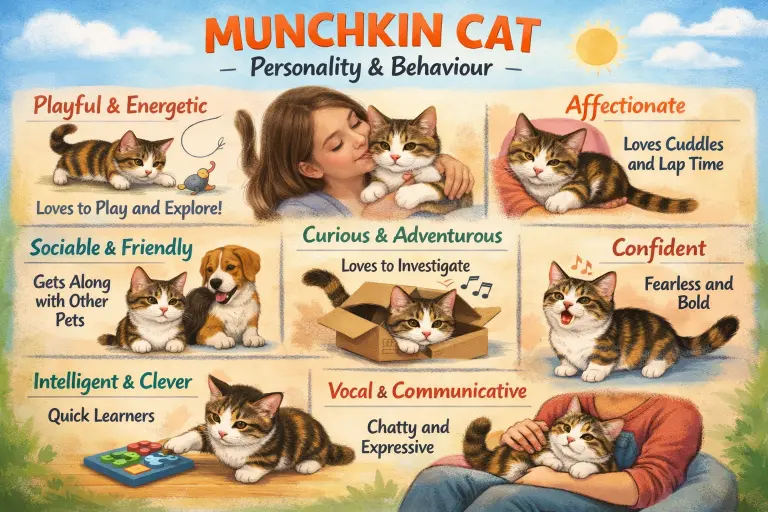
Munchkin cats are best known for their short legs, but their personality is what truly stands out once you live with one. In everyday life, most Munchkins come across as curious, social, and surprisingly confident. They tend to move through the world with a “small body, big attitude” energy, showing interest in what people are doing rather than staying distant or aloof.
Many Munchkins enjoy being near their humans, even if they are not always lap cats. Some like to sit beside you, others prefer to follow you from room to room. This behavior often gets misunderstood as neediness, but it is usually simple social curiosity. They like knowing what is happening in their space.
Their shorter legs do not limit their personality. Instead, Munchkins often adapt creatively. You may see them hopping onto furniture in stages, standing upright on their back legs, or choosing lower perches where they can still watch everything. These adjustments are normal and show problem-solving skills, not weakness.
It is important to remember that not every Munchkin is the same. Personality is shaped by genetics, early experiences, and the home environment. Some are very outgoing, while others are calm observers. The breed gives a general pattern, but the individual cat always matters more.
| Personality Trait | How It Commonly Shows | What It Means |
|---|---|---|
| Social curiosity | Follows people, watches closely | Interested, not clingy |
| Playfulness | Enjoys short bursts of play | Likes mental stimulation |
| Confidence | Explores new rooms calmly | Feels secure in space |
| Affection style | Sits nearby, gentle contact | Shows trust in subtle ways |
Munchkin Social Style: With Humans, Children & Other Pets
Munchkin cats often enjoy social contact, but they usually prefer gentle and respectful interaction. With adults, they tend to bond through routine. Sitting nearby during work, joining you on the couch, or greeting you at the door are common ways they connect.
With children, many Munchkins do well when kids are calm and understand boundaries. Because Munchkins are low to the ground, they can feel overwhelmed by fast movement or loud handling. When children are taught to sit quietly and let the cat come to them, these cats often become friendly companions.
When living with other cats or dogs, Munchkins usually rely on observation first. They like to watch before joining in. This can look like shyness, but it is often careful social assessment. Once comfortable, many Munchkins play or rest peacefully with other pets.
Social behavior can change with age. Kittens are often more playful and bold, while adults may become more selective about interaction. This shift is normal and does not mean the cat has become unfriendly.
Communication: What Munchkins Say With Body Language & Vocalizations
Munchkin cats communicate clearly, but often quietly. Many are not overly vocal, choosing body signals over constant sounds. When they do meow, it is usually short and purposeful, such as asking for attention or greeting someone.
Their body language is similar to other cats, but owners sometimes miss subtle signs because they expect loud or dramatic signals. A slow tail movement, relaxed ears, or half-closed eyes usually mean the cat feels calm and safe. Standing on their back legs to look around is often curiosity, not begging.
Some Munchkins chirp or trill instead of long meows. This sound is often used during play or when following a person. It usually means interest or excitement rather than distress.
Learning your cat’s personal signals matters more than memorizing rules. Over time, you will notice patterns that help you understand when your Munchkin wants space, play, or simple companionship.
Play, Energy & Natural Instincts in Munchkins
Munchkin cats are playful, but their play style is often short and focused. Instead of long high-speed chases, many enjoy interactive toys, gentle stalking games, and puzzle-style play. This fits their body structure and natural instincts well.
They still have strong hunting behavior. You may see stalking, pouncing, or toy carrying. These actions are healthy and important for mental balance. Short legs do not remove these instincts, they just change how the cat uses them.
Many Munchkins enjoy floor-level play more than high climbing. Rolling toys, wand toys kept low, and hide-and-seek games work well. When owners match play to the cat’s natural movement style, the cat often appears more confident and relaxed.
Energy levels can vary. Some Munchkins stay playful into adulthood, while others become calmer earlier. Both patterns are normal and should not be judged as lazy or hyper.
Common Misunderstood Behaviors & What They Really Mean
One common misunderstanding is that Munchkins are sad or limited because they do not jump as high. In reality, most adapt their environment and show no signs of frustration. Choosing a lower route is usually a smart choice, not a problem.
Another misunderstood behavior is hoarding toys or hiding objects. This is linked to hunting instincts, not anxiety. Many cats, including Munchkins, like to gather “prey” in safe spots.
Some owners worry when a Munchkin prefers nearby presence instead of cuddling. This is a valid affection style. Sitting close, watching, or sleeping at your feet can be a strong sign of trust.
Finally, slower movement or more resting with age is normal. Behavior changes across life stages are expected and do not automatically signal illness or unhappiness.For further reading on feline behavior science, you can explore this resource:
https://icatcare.org/advice/understanding-your-cats-behaviour/

Ata Ur Rehman is the founder of Pet Age in Human Years Calculator, an educational platform that provides age conversion charts and lifespan guides for dogs, cats, birds, and other companion animals. His work focuses on helping pet owners understand how animal ages translate into human years using commonly accepted age conversion formulas and published lifespan averages.
The website compiles breed and species lifespan data from kennel clubs, breed organizations, and general animal lifespan studies to present simple and easy-to-understand guides for pet owners worldwide.
This website was created to centralize animal age conversion charts into one easy reference platform for pet owners.