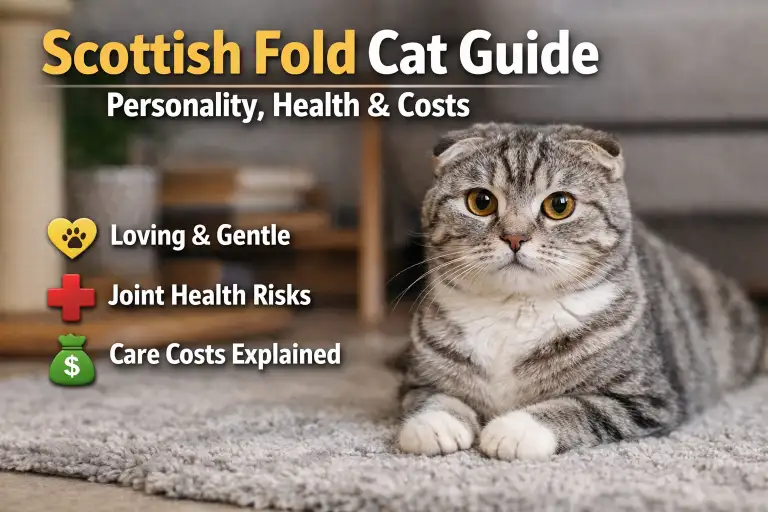
The Scottish Fold cat is instantly recognizable for its folded ears and wide, round eyes that give it a permanently sweet, almost owl-like expression. But beyond the appearance, this breed is known for its calm temperament, strong attachment to its people, and a controversial genetic trait that every prospective owner should fully understand.
Originally discovered in Scotland in the 1960s, the folded ears are the result of a natural genetic mutation affecting cartilage. That same mutation, however, also influences joint development throughout the body — something we’ll explore in detail later. For now, it’s important to know that the Scottish Fold is as much a lifestyle commitment as it is a visual preference.
Size and weight
Scottish Folds are medium-sized cats with a rounded, sturdy build.
- Males typically weigh between 9–13 pounds (4–6 kg)
- Females usually weigh 6–9 pounds (2.7–4 kg)
- Most reach full physical maturity between 12–18 months
They are not particularly tall cats, but they feel solid when picked up due to their dense bone structure. Unlike lean, athletic breeds such as the Abyssinian, the Scottish Fold has a more compact, plush body type.
Lifespan
A well-bred Scottish Fold generally lives between 11–15 years. However, longevity can vary depending on the severity of cartilage-related joint issues. Cats bred responsibly (Fold × Straight pairings) often have better long-term mobility outcomes than poorly bred lines.
Personality at a glance
Scottish Folds are widely described as gentle, observant, and deeply bonded to their humans. In real homes, they tend to:
- Follow their favorite person from room to room
- Sit nearby rather than demand constant attention
- Enjoy quiet companionship over chaotic activity
- Prefer routine and predictable environments
They are not typically hyperactive or highly vocal. Instead of dramatic meowing, they often communicate through soft chirps or simply by staring at you expectantly.
Energy and activity level
This breed has a low-to-moderate energy level. They enjoy interactive play but are not high-jumpers or extreme climbers. Many owners notice that their Fold prefers floor-based toys rather than scaling tall cat trees — partly due to body structure and, in some cases, joint comfort.
Affection level vs independence
Scottish Folds are affectionate without being overwhelming. They often form a strong primary bond but tolerate short periods alone reasonably well. That said, they are not ideal for homes where they are ignored for long hours daily.
Indoor vs outdoor suitability
Because of potential joint vulnerabilities and their trusting nature, Scottish Folds are best suited to indoor-only environments. Outdoor living increases the risk of injury, especially for cats with underlying cartilage weakness.
Apartment compatibility
Excellent. Their moderate energy level and quiet voice make them particularly well-suited for apartments, condos, and smaller homes.
Scottish Fold at-a-glance
| Trait | Details |
|---|---|
| Origin | Scotland |
| Average Weight | Male: 9–13 lbs / Female: 6–9 lbs |
| Lifespan | 11–15 years |
| Energy Level | Low–Moderate |
| Affection Level | High |
| Vocalization | Low |
| Shedding | Moderate |
| Health Risk Level | Elevated (genetic joint mutation) |
| Best For | Calm, indoor households |
Before choosing this breed based on appearance alone, it’s essential to understand both the charm and the responsibility that come with owning a Scottish Fold. In the next section, we’ll explore what living with one truly feels like — beyond the folded ears.
Appearance & Personality: What Living With a Scottish Fold Is Really Like
At first glance, the Scottish Fold looks soft, round, and almost teddy-bear-like. But living with one is about much more than cute folded ears. Their body shape, movement style, and personality all work together to create a very specific home experience.
Physical appearance
Scottish Folds have a medium-sized body with a rounded shape. Nothing about them looks sharp or extreme. Even their paws and face look soft and curved.
They have:
- A round head
- Large, wide-set eyes
- Short to medium nose
- Thick neck
- Dense, plush coat
- Medium-length tail (should bend smoothly, not stiff)
The ears are the most famous feature. Some folds are light (single fold), while others are tighter (double or triple fold). Not all kittens are born with folded ears. Some develop straight ears and are called Scottish Straights.
There are two coat types:
- Short-haired (most common)
- Long-haired, also called Highland Fold
They come in many colors and patterns, including solid, tabby, bi-color, and more.
Personality in real life
Scottish Folds are calm and gentle. They are not loud or dramatic. They like being near people but do not usually demand attention all day.
Many owners notice these common behaviors:
- They follow one person around the house.
- They sit beside you instead of always on your lap.
- They enjoy quiet time more than wild play.
- They like routine and do not enjoy too much change.
They are not very talkative. Their voice is soft. You will not hear loud, constant meowing like you might with a Siamese cat.
Affection and bonding
Scottish Folds often bond closely with one main person. They like to sit near you while you work, watch TV, or relax. Some enjoy being lap cats, but many prefer sitting next to you instead.
They are loving, but in a calm way.
Independence level
They can stay alone for short periods, but they should not be ignored every day for long hours. They enjoy company and feel safest when their home routine is steady.
Behavior with children
Scottish Folds usually do well with gentle children. They do not enjoy rough handling or loud, chaotic play. Calm older children are usually a better match than very young toddlers.
Behavior with other cats
They are not usually dominant. In multi-cat homes, they tend to avoid fights. They prefer peaceful companions rather than very active or aggressive cats.
Behavior with dogs
They can live with calm dogs if introduced slowly. Very energetic dogs may stress them.
Play style
They like soft, slow play. Wand toys, rolling balls, and light puzzle toys are good choices. They are not extreme jumpers or climbers. Many prefer ground-level play instead of tall cat trees.
Common myths
Some people say Scottish Folds are lazy. That is not fully true. They do play and explore. They are just more relaxed than high-energy breeds.
Another myth is that all of them sit in funny human-like positions. While many do sit upright (often called the “Buddha sit”), not every Fold does this.
Personality snapshot
| Trait | Level | What It Means |
|---|---|---|
| Affection | High | Likes being near people |
| Activity | Low–Moderate | Gentle play, not athletic |
| Vocalization | Low | Quiet, soft voice |
| Independence | Moderate | Can handle short alone time |
| Social with Pets | Good | Prefers calm companions |
Living with a Scottish Fold feels peaceful. They bring a soft, quiet presence into the home. But their sweet nature should never distract from the health concerns linked to their folded ears.
Health, Genetics & Ethical Concerns
This is the most important section of this guide.
The folded ears that make the Scottish Fold famous are caused by a genetic mutation. This mutation does not only change the ears. It affects cartilage in the whole body. Cartilage is the soft tissue that helps joints move smoothly.
Because of this, Scottish Folds can develop bone and joint problems.
What is osteochondrodysplasia?
Osteochondrodysplasia is a long medical word. It means abnormal bone and cartilage growth.
In simple terms:
- The same gene that folds the ears can also damage joints.
- It can cause pain, stiffness, and arthritis.
- It can affect the tail, legs, and spine.
Some cats are mildly affected. Others can have serious mobility problems.
Early signs owners should watch for
- Stiff tail that does not bend easily
- Limping
- Trouble jumping
- Swollen joints
- Less interest in playing
- Walking in a stiff way
These signs may start when the cat is still young.
Do all Scottish Folds suffer?
Not all Scottish Folds show severe pain. Some live fairly normal lives. But every cat with folded ears carries this gene. There is no folded ear without the mutation.
Responsible breeders try to reduce risk by breeding:
- Scottish Fold × Scottish Straight
Never Fold × Fold
Even with careful breeding, the gene is still present.
Why is the breed controversial?
Some countries and veterinary groups have concerns about breeding Scottish Folds. They believe it is not ethical to breed cats with a known genetic disorder.
In some places, breeding Scottish Folds is restricted or banned.
This does not mean every Scottish Fold is suffering. But it does mean future owners must understand the risk.
Other common health concerns
Besides joint disease, Scottish Folds may also face:
- Arthritis as they age
- Obesity (because they are less active)
- Tail stiffness
- Possible heart or kidney issues (like many purebred cats)
Health risk summary
| Condition | Cause | Risk Level | What Owners Should Do |
|---|---|---|---|
| Osteochondrodysplasia | Genetic mutation | High | Regular vet checkups |
| Arthritis | Joint damage | Moderate–High | Monitor movement |
| Obesity | Low activity | Moderate | Control diet |
| Tail stiffness | Cartilage defect | Moderate | Gentle handling |
Vet care and monitoring
Scottish Folds need regular veterinary visits. A good vet will:
- Check joint movement
- Examine tail flexibility
- Watch weight closely
- Suggest pain support if needed
Pet insurance is strongly recommended. Joint treatment can become expensive over time.
Long-term reality
Owning a Scottish Fold may mean managing joint health for many years. Some cats live comfortably with mild issues. Others may need medication or special care.
This breed requires honesty, preparation, and financial planning.
Care Needs, Activity Level & Daily Maintenance
Scottish Folds are not high-energy cats, but they still need daily care and attention. Because of their joint risks, their care must be gentle and thoughtful.
Daily activity level
Scottish Folds have low to moderate energy. They enjoy short play sessions but do not usually run or jump a lot.
Good play ideas:
- Feather wand toys moved slowly
- Soft balls rolled on the floor
- Puzzle toys with treats
- Short, gentle chase games
Avoid:
- Very high cat trees
- Long jumping games
- Rough or fast play
Their joints may not handle too much impact.
Mental stimulation
Even calm cats need brain activity. Scottish Folds are smart and observant.
You can help by:
- Rotating toys every few days
- Using food puzzles
- Teaching simple tricks
- Giving window views for bird watching
Bored cats may gain weight or become lazy.
Grooming needs
Short-haired Scottish Folds:
- Brush 1–2 times per week
- Moderate shedding
Long-haired (Highland Fold):
- Brush 3–4 times per week
- Higher risk of tangles
- More seasonal shedding
Ear care is very important. Because their ears fold forward, dirt can build up inside.
Check weekly for:
- Bad smell
- Redness
- Dark debris
Clean gently using vet-approved products.
Nail and dental care
- Trim nails every 2–3 weeks
- Provide scratching posts
- Brush teeth several times per week
- Offer dental treats if recommended
Weight control
Because they are not very active, Scottish Folds can gain weight easily. Extra weight puts more pressure on their joints.
To prevent obesity:
- Measure food portions
- Avoid too many treats
- Keep daily play consistent
Home environment
Scottish Folds do best indoors. Outdoor life can increase injury risk, especially if joint issues develop.
They are great for:
- Apartments
- Small homes
- Calm families
- Seniors
- First-time owners who are responsible
They are not ideal for:
- Very noisy homes
- Homes with rough children
- Highly active dog households
Care requirements snapshot
| Category | Level | Notes |
|---|---|---|
| Exercise | Low–Moderate | Gentle play only |
| Grooming | Moderate | Long hair needs more brushing |
| Training | Easy | Responds to positive methods |
| Weight Control | Important | Prevent joint strain |
| Indoor Living | Strongly Recommended | Safer for joints |
Scottish Folds are not difficult cats, but they need mindful care. Protecting their joints and keeping them at a healthy weight is key to a better life.
Cost, Pros & Cons & Similar Breeds to Consider
Before choosing a Scottish Fold, you must understand the full cost. This breed can be more expensive than many other cats, especially because of possible joint problems.
How much does a Scottish Fold kitten cost?
The price depends on the breeder, location, and bloodline.
Typical kitten price:
- Pet quality: $1,000–$2,500
- Show quality: $2,500–$4,000+
Very cheap prices can be a red flag. Responsible breeders test their cats and do not breed Fold × Fold.
Yearly care costs
Basic yearly expenses may include:
- Food
- Litter
- Regular vet visits
- Vaccinations
- Grooming supplies
Average routine care per year: $600–$1,200
Possible extra medical costs
Because of joint risks, some Scottish Folds may need:
- X-rays
- Pain medication
- Joint supplements
- Special diets
- More frequent vet visits
These costs can vary widely. Some cats may need very little extra care. Others may need long-term treatment.
Pet insurance is strongly recommended. It can help cover joint-related issues if enrolled early.
Cost breakdown
| Expense | Estimated Range |
|---|---|
| Kitten Price | $1,000–$4,000+ |
| Annual Routine Care | $600–$1,200 |
| Insurance (Monthly) | $25–$60 |
| Joint Treatment (If Needed) | Varies greatly |
Pros and cons
Every breed has strengths and weaknesses. It is important to look at both sides honestly.
Pros
- Very sweet and gentle personality
- Strong bond with owners
- Quiet and calm
- Good for apartments
- Unique and beautiful appearance
Cons
- Genetic joint disorder risk
- Possible lifelong medical care
- Higher purchase price
- Ethical concerns about breeding
- May have limited mobility later in life
Pros and cons table
| Pros | Cons |
|---|---|
| Loving and calm | Joint health risks |
| Quiet voice | Possible chronic pain |
| Great for small homes | Higher vet costs |
| Unique folded ears | Ethical controversy |
Similar breeds to consider
If you love the round face and calm personality but worry about health risks, there are safer alternatives.
Scottish Straight
Looks similar but has normal ears. Much lower joint risk.
British Shorthair
Round face, calm personality, and strong body. Generally healthier joints.
American Curl
Unique ears that curl backward, but without the same cartilage disorder risk.
Breed comparison
| Breed | Health Risk | Personality | Activity Level | Best For |
|---|---|---|---|---|
| Scottish Fold | Higher | Gentle, attached | Low–Moderate | Calm indoor homes |
| Scottish Straight | Lower | Similar temperament | Moderate | Safer alternative |
| British Shorthair | Low | Independent but calm | Moderate | Busy households |
| American Curl | Low | Social and playful | Moderate | Families wanting unique look |
Final thoughts
Scottish Folds are loving, peaceful cats. They fit well in quiet homes and apartments. But their folded ears come with real health concerns.
If you choose this breed, choose a responsible breeder, prepare for possible medical costs, and focus on giving the cat a safe indoor life.
For more detailed information about feline genetic health and inherited conditions, you can visit the Cornell University College of Veterinary Medicine’s feline health resource page.

Ata Ur Rehman is the founder of Pet Age in Human Years Calculator, an educational platform that provides age conversion charts and lifespan guides for dogs, cats, birds, and other companion animals. His work focuses on helping pet owners understand how animal ages translate into human years using commonly accepted age conversion formulas and published lifespan averages.
The website compiles breed and species lifespan data from kennel clubs, breed organizations, and general animal lifespan studies to present simple and easy-to-understand guides for pet owners worldwide.
This website was created to centralize animal age conversion charts into one easy reference platform for pet owners.