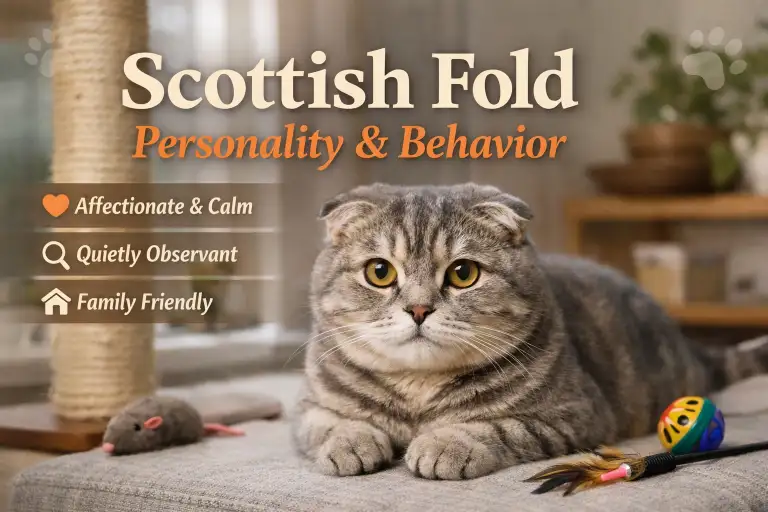
Scottish Folds are often described as sweet, calm, and affectionate — but those words only scratch the surface of who they really are. While the breed is known for its distinctive folded ears and gentle expression, personality is not shaped by appearance alone. Like all cats, Scottish Folds are individuals first and a breed second.
If you’re researching Scottish Fold personality and behavior, you’re likely wondering:
Are they affectionate?
Are they clingy or independent?
Are they playful or lazy?
Are they quiet?
Are they good with families?
The short answer is this: most Scottish Folds are emotionally attuned, moderately affectionate, and calmly observant — but how that shows up depends heavily on environment, upbringing, and individual temperament.
Scottish Folds tend to form steady, secure attachments rather than dramatic or demanding ones. Many are what behaviorists informally call “proximity cats.” Instead of constantly seeking to be held, they prefer to sit beside you, follow you from room to room, or quietly supervise your activities. Their affection is often subtle but consistent.
They are generally not high-drama cats. You’re less likely to see extreme vocalization or chaotic bursts of energy compared to some more active breeds. Instead, their behavior often feels thoughtful and measured. They watch first, act second.
That said, not every Scottish Fold will match the breed stereotype. Some are highly playful. Some are more reserved. Some adore being carried; others prefer all four paws on the ground. Early socialization, daily interaction, and household atmosphere influence personality just as much as genetics.
It’s also important to understand that their folded ears do not dictate their emotional state. A Scottish Fold’s ear shape is a physical trait — not a built-in temperament indicator. Their emotional communication still relies on posture, tail position, eyes, and subtle body tension just like any other cat.
At a glance, most Scottish Folds tend to be:
- Calm but not inactive
- Affectionate but not overly demanding
- Observant and sensitive to household energy
- Moderately playful with bursts of hunting-style activity
- Quiet communicators rather than constant meowers
Understanding Scottish Fold personality starts with seeing them as emotionally nuanced animals — not as “cute quiet cats” or “laid-back lap pets.” When you learn to read their subtle signals and respect their gentle style, their behavior makes much more sense.
Core Personality Traits: Affection, Attachment & Temperament
Scottish Fold personality is often described as gentle, calm, and loving. While that is mostly true, their affection is usually quiet and steady rather than loud or dramatic.
They are not usually the type of cat that demands constant attention. Instead, they prefer to stay close to you and be part of your daily life in a peaceful way.
Affection Style: Lap Cat or Nearby Cat?
Many Scottish Folds are what people call “nearby cats.” This means they like sitting next to you instead of on top of you. Some enjoy laps, but many are happiest sitting beside you on the couch, at your feet, or on a chair nearby.
You might notice:
- Following you from room to room
- Sitting quietly while you work
- Sleeping close but not always touching
- Leaning gently against you
This does not mean they are distant. It simply means their love language is calm presence.
Do They Bond with One Person?
Scottish Folds often form a strong bond with one main person in the home. They may still be friendly with everyone, but they sometimes choose a “favorite.”
This usually shows as:
- Greeting one person first
- Sleeping near the same person often
- Watching that person closely
This is normal cat behavior and not a sign of jealousy or dislike toward others.
Are They Clingy or Independent?
Most Scottish Folds sit in the middle. They enjoy company, but they can also relax alone for a few hours without stress.
They usually:
- Like routine
- Feel secure in calm homes
- Prefer gentle interaction
They are not highly needy, but they do not like being ignored for long periods either.
Calm vs Playful
Scottish Folds are calm, but they are not lazy. They often have short bursts of playful energy. You may see them suddenly run, chase a toy, or pounce on something invisible.
After a few minutes of play, they often return to resting or watching.
They enjoy:
- Wand toys
- Slow hunting-style games
- Puzzle feeders
- Quiet interactive play
They are usually not wild climbers or nonstop runners like some high-energy breeds.
Personality Traits at a Glance
Here is a simple breakdown of common Scottish Fold traits:
| Trait | What It Looks Like | What It Means |
|---|---|---|
| Affection | Sits near you | Feels safe and attached |
| Independence | Rests alone calmly | Comfortable in their space |
| Playfulness | Short active bursts | Natural hunting instinct |
| Sensitivity | Reacts to loud noise | Emotionally aware |
| Loyalty | Follows one person often | Strong bonding behavior |
Remember, these are common patterns, not rules. Every cat is different.
Communication Style: Body Language & Vocal Behavior
Scottish Folds are usually quiet cats. They do not meow loudly or often like some other breeds. But quiet does not mean silent. They still communicate — just in softer ways.
If you learn to watch small changes in their body, you can understand how they feel.
Are Scottish Folds Vocal?
Most Scottish Folds:
- Use soft meows
- Make small chirps or trills
- Meow gently when hungry or greeting you
They are not known for constant loud talking. If your Scottish Fold is quiet, that is normal for the breed.
Sometimes silence is also a message. A cat that suddenly becomes much quieter than usual may simply be observing. Cats often watch first and react later.
Body Language Signals to Watch
Cats speak with their whole body. Scottish Folds are no different.
Eyes
- Slow blinking = relaxed and trusting
- Soft eyes = calm
- Wide eyes with stiff body = alert or unsure
Tail
- Tail up = friendly and confident
- Tail loosely wrapped = relaxed
- Tail tucked tightly = nervous
Posture
- Loose loaf position = comfortable
- Stretching out on their side = feels safe
- Crouched low with tight body = unsure
Ear Position Myth
Many people think folded ears mean the cat looks sad or upset. This is not true. The fold is just a physical trait. You must look at the tail, eyes, and body tension to understand their mood.
Comfort vs Stress Signals in Scottish Folds
Here is a simple comparison to help you tell the difference:
| Relaxed & Happy | Unsure or Stressed |
|---|---|
| Slow blinking | Avoiding eye contact |
| Tail up loosely | Tail tucked close |
| Sleeping in open areas | Hiding often |
| Soft body posture | Stiff body |
| Gentle chirps | Very quiet and withdrawn |
Small changes matter. A calm cat has a loose body. A stressed cat has a tight body.
Scottish Folds are very sensitive to tone and energy in the home. Loud voices or sudden changes may make them pull back quietly instead of reacting strongly.
Social Behavior with Families, Children & Other Pets
Scottish Folds are usually gentle and patient cats. They like calm homes where people move and speak in a soft way. They enjoy being part of family life, but they do not like too much noise or rough play.
Are Scottish Folds Good with Families?
Yes, most Scottish Folds do well in families, especially if the home is peaceful.
They often:
- Sit in the same room as everyone
- Watch family activities quietly
- Join in during calm play time
- Rest near people in the evening
They are not usually attention-seeking. They like being included but do not demand to be the center of attention.
Are They Good with Children?
Scottish Folds can do well with children who are gentle and respectful.
They are more comfortable with:
- Older kids who understand how to handle cats
- Calm voices
- Slow movements
They may walk away if play becomes too loud or rough. This is not bad behavior. It simply means they need space.
Do They Get Along with Other Cats?
Many Scottish Folds can live peacefully with other cats, especially if the other cat is not too dominant or overly active.
They prefer:
- Cats with similar calm energy
- Clear personal space
- Slow introductions
They are not usually aggressive. But they also do not enjoy constant chasing or rough wrestling.
Living with Dogs
Scottish Folds can live with dogs if:
- The dog is calm
- The dog is trained not to chase
- They are introduced slowly
Because Scottish Folds are not high-energy cats, they may feel stressed around very active dogs.
Do They Choose a Favorite Person?
Yes, many Scottish Folds pick one person they feel closest to. This shows as:
- Following that person more
- Sitting near them often
- Greeting them at the door
They still care about others in the home. They just build deeper trust with one person.
Scottish Folds are not dramatic in social situations. If they feel uncomfortable, they usually move away instead of acting out.
Activity Level, Play Style & Natural Instincts
Many people think Scottish Folds are lazy because they look calm. But calm does not mean lazy. They simply use their energy in a quiet and steady way.
Are Scottish Folds Playful?
Yes, most Scottish Folds enjoy play. They just do not play in a wild or nonstop way.
You may notice:
- Short bursts of running
- Sudden pouncing on toys
- Watching a toy carefully before attacking
- Quiet stalking movements
They often play in a focused way, like a hunter. After a few minutes, they may stop and rest.
This pattern is normal cat behavior.
Do They Have Hunting Instincts?
Even calm cats have strong hunting instincts. Scottish Folds enjoy:
- Wand toys
- Feather toys
- Small moving objects
- Puzzle feeders
They like games where they can stalk, chase, and pounce. This matches their natural behavior in the wild.
Are They Active at Night?
Like most cats, Scottish Folds are more active in the early morning and evening. This is called being “crepuscular.” It means they are naturally awake during dawn and dusk.
You may hear:
- Light running
- Soft jumping
- Gentle playing
This is normal and not a behavior problem.
Do They Climb and Scratch?
Scottish Folds do scratch and climb, but usually in a moderate way.
They enjoy:
- Scratching posts
- Low to medium cat trees
- Window perches
They are not always extreme climbers, but they still need places to stretch and scratch.
Calm vs Low Energy: What’s the Difference?
Some owners worry that their Scottish Fold seems too quiet. Here is a simple guide to understand the difference:
| Calm Temperament | Low Engagement |
|---|---|
| Watches quietly | Avoids all interaction |
| Plays for short periods | Refuses to play at all |
| Sleeps in open areas | Hides most of the day |
| Moves slowly but confidently | Moves stiffly or hesitates |
Most Scottish Folds are calm by nature. They enjoy peace. That does not mean something is wrong.
Behavior Changes with Age & Commonly Misunderstood Traits
Scottish Fold personality can change over time. This is normal. Just like people, cats grow and adjust as they age.
Kitten Stage
Scottish Fold kittens are usually more active and curious than adults. They may:
- Run suddenly around the house
- Climb more often
- Play for longer periods
- Explore everything
This high energy is normal for kittens. It does not always mean they will stay that active as adults.
Teen and Young Adult Stage
As they grow, their energy may still be strong, but it becomes more controlled.
You may notice:
- Strong hunting-style play
- Testing small limits
- Wanting more attention at times
This stage is about learning and building confidence.
Adult Stage
Most adult Scottish Folds become calmer and more steady in their behavior.
They often:
- Prefer routine
- Rest near their favorite person
- Play in short sessions
- Avoid loud or busy spaces
Their personality feels more settled and predictable.
Senior Stage
Older Scottish Folds may slow down even more.
You might see:
- More sleeping
- Less jumping
- More desire for quiet time
- Strong attachment to one safe space
This is a natural part of aging.
Commonly Misunderstood Traits
“They are lazy.”
Scottish Folds are usually calm, not lazy. They conserve energy and move with purpose.
“They look sad.”
Their folded ears can make them look serious. But ear shape does not show emotion. Always look at their body and tail.
“They are shy.”
Some are reserved at first. This is not fear. It is careful observation.
“They don’t love me because they don’t sit on my lap.”
Many Scottish Folds show love by staying nearby instead of sitting on you.
When to Pay Attention
If a Scottish Fold suddenly:
- Stops interacting completely
- Hides all day
- Changes eating habits
- Becomes very vocal without reason
It may be worth observing closely and speaking with a professional. Sudden big changes are different from normal personality shifts.
For a deeper science-based understanding of how cats communicate through body language and social signals, you can explore the International Cat Care behavior guides.

Ata Ur Rehman is the founder of Pet Age in Human Years Calculator, an educational platform that provides age conversion charts and lifespan guides for dogs, cats, birds, and other companion animals. His work focuses on helping pet owners understand how animal ages translate into human years using commonly accepted age conversion formulas and published lifespan averages.
The website compiles breed and species lifespan data from kennel clubs, breed organizations, and general animal lifespan studies to present simple and easy-to-understand guides for pet owners worldwide.
This website was created to centralize animal age conversion charts into one easy reference platform for pet owners.